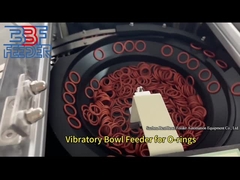
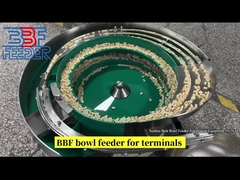
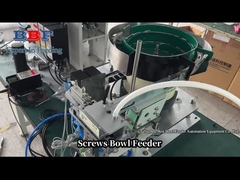
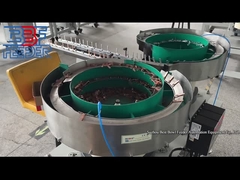
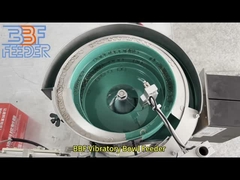
OEM/ODM Vibratory Bowl Feeder Machine Rotary Orienting Metal Screws Feeding System

Other Videos
October 15, 2025
Category Connection: Screw Bowl Feeder
Brief: Stay tuned as we highlight the most important features and real-use results. In this video, you'll see a detailed walkthrough of our OEM/ODM Vibratory Bowl Feeder Machine, specifically designed for rotary orienting and feeding metal screws in automated production lines. We demonstrate how it handles challenging components like springs and explore material selections for medical manufacturing environments.
Related Product Features:
  • Constructed from corrosion-resistant materials like stainless steel (SUS304) or FDA-compliant plastics for medical applications.
  • Features easy disassembly and cleaning design to minimize bacterial accumulation and maintain product sterility.
  • Equipped with customizable controllers from brands like CUH, Sanki, Sinfonia, REO, and Afag.
  • Available in multiple power options including 300W, 500W, 1000W, 1500W, and 2000W to suit various production needs.
  • Offers adjustable amplitude, frequency, and angle parameters to optimize conveying for different spring shapes and sizes.
  • Includes auxiliary devices like separators to prevent spring entanglement and ensure stable, accurate feeding.
  • Integrated with automation equipment such as sensors and PLC control systems for real-time monitoring and speed regulation.
  • Backed by comprehensive after-sales support including spare parts, technology assistance, and a 2-year warranty with CE, ISO9001, and ROHS certifications.
Faqs:
  • What materials are available for the vibratory bowl feeder to ensure compatibility with medical manufacturing environments?
    The vibratory bowl feeder is constructed from corrosion-resistant materials such as stainless steel (SUS304) or FDA-compliant plastics, specifically chosen to withstand sterilizers and cleaning agents used in medical production settings.
  • How does the feeder handle challenging components like springs that may tangle or clog during conveyance?
    The system addresses spring handling through adjustable amplitude, frequency, and angle parameters, along with optimized track designs and auxiliary separators to prevent entanglement and ensure smooth, stable feeding without clogging.
  • What control and monitoring features are included to maintain optimal feeding speed and accuracy?
    The feeder integrates automation equipment including sensors and PLC control systems that monitor and regulate the conveying process in real time, maintaining consistent speed and preventing issues from springs being conveyed too fast or too slow.