Eliminate Manual Feeding Bottlenecks: Vibratory Bowl Feeders Stabilize Assembly Line Throughput
In many modern factories, production speed is no longer limited by machining or testing—it is limited by feeding. When operators manually pick, sort, and place small components, the line often suffers from manual feeding inefficiency, inconsistent pacing, and unexpected stops. These issues quickly become a bottleneck in assembly line automation, especially for fast-moving products that require stable part presentation and accurate orientation.
A Vibratory Bowl Feeder (also known as a vibratory parts feeder or bowl feeder) is designed to solve exactly this problem: turning bulk parts into a reliable, continuous, and controllable flow for automated equipment. For manufacturers looking to increase throughput while maintaining quality, investing in a vibratory bowl feeder system is one of the most direct ways to reduce downtime and stabilize production.
Why manual feeding becomes a hidden bottleneck
Manual feeding may look flexible, but it is often the source of several critical pain points:
1) Unstable feeding and frequent interruptions
Operators can’t maintain the same speed for long shifts, causing inconsistent speed, low throughput, and line imbalance. When the feeding rate drops, upstream machines and downstream stations have to wait, creating a chain reaction of lost efficiency.
2) Misfeeds, double-feeding, and orientation errors
Many parts—such as screws, nuts, connectors, terminals, or precision metal components—must be presented in a specific orientation. Manual loading often leads to misfeed, double feed, and parts orientation problems, which can increase scrap and slow rework processes.
3) Rising labor cost and higher defect risk
With labor costs increasing globally, manual feeding is a high-cost method with limited scalability. It also contributes to a high defect rate due to human variation, especially during high-speed production or night shifts.
Application scenarios: where a vibratory bowl feeder delivers the most value
A vibratory feeder bowl is widely used across automation lines because it can integrate smoothly into multiple industrial processes:
-
Assembly Line Automation for automotive components, electronics, and precision parts
-
Pick and Place feeding to support robots and high-speed manipulators
-
Packaging line feeding where stable part flow prevents packaging delays
-
Automatic parts sorting & feeding for small metal parts and fasteners
-
Screws / bolts / nuts feeding with controlled orientation and spacing
Whether you are building a new production line or upgrading an existing one, a vibratory bowl feeder system can act as the “front-end stabilizer” that ensures every downstream station receives parts consistently.
The solution: a customizable Vibratory Bowl Feeder system
At Suzhou Best Bowl Feeder Automation Equipment Co., Ltd., we support manufacturers who want reliable feeding performance with flexible customization. Our Vibratory Bowl Feeder solutions are engineered for stable output and easy integration, especially in projects that require precision control and multiple power options.
Core specifications that customers care about
To meet different production requirements, our bowl feeder solutions can be configured with the following key parameters:
-
Material options: Aluminum AL7075 or Stainless Steel SUS304 (or based on customers’ requirements)
-
Controller compatibility: CUH, Sanki, Sinfonia, REO, Afag
-
Voltage/frequency: 220V 50Hz / 110V 60Hz (or customized to your local standard)
-
Power range: 300W / 500W / 1000W / 1500W / 2000W
-
Speed: based on customers’ requirements for line takt time and throughput goals
-
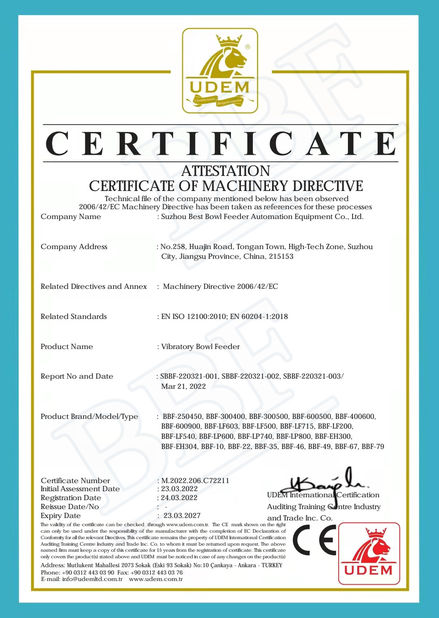
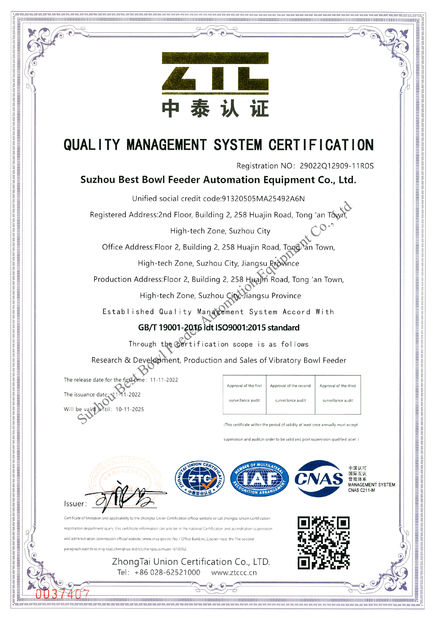
Certification: CE, ISO9001, ROHS
-
Warranty: 2 years
-
Lead time: 3 working weeks for standard project timelines
These parameters are designed around practical integration needs—especially for international customers who require voltage adaptation and controller matching.
Results: measurable improvements in throughput and stability
When implemented correctly, a vibratory parts feeder can deliver clear outcomes:
-
Stable feeding that reduces line stops and improves overall equipment effectiveness (OEE)
-
Lower risk of feeding jam, misfeed, and downtime
-
Improved consistency for robotic cells, reducing pick failure and cycle-time variation
-
Reduced dependence on manual labor, helping control operating costs
-
A more predictable production rhythm, improving delivery performance and customer satisfaction
In short, a well-designed industrial feeding equipment solution doesn’t just feed parts—it protects your production schedule.
Final thoughts
If your factory is experiencing manual feeding bottlenecks, frequent interruptions, or inconsistent line speed, upgrading to a Vibratory Bowl Feeder is one of the fastest ways to stabilize throughput. With customizable materials like AL7075 and SUS304, broad controller compatibility (CUH, Sanki, Sinfonia, REO, Afag), and flexible voltage options, you can implement a system that fits your exact production environment.
For manufacturers seeking a reliable bowl feeder partner, Suzhou Best Bowl Feeder Automation Equipment Co., Ltd. provides engineering-focused solutions that support long-term stability, fast deployment, and scalable automation.
Looking to optimize your feeding process? Share your part type, size, target speed, and line layout requirements, and our team can recommend a suitable vibratory bowl feeder system configuration for your application.

 Your message must be between 20-3,000 characters!
 English